The science behind botanical hair color
Plant-based hair dye offers something fundamentally different from conventional color. It does not overwrite your hair—it works with it.
At the heart of this process lies henna, one of the most refined and time-tested botanical colorants. To understand its unique results, it helps to look closely at how it interacts with the hair itself.
The Active Pigment: Lawsone
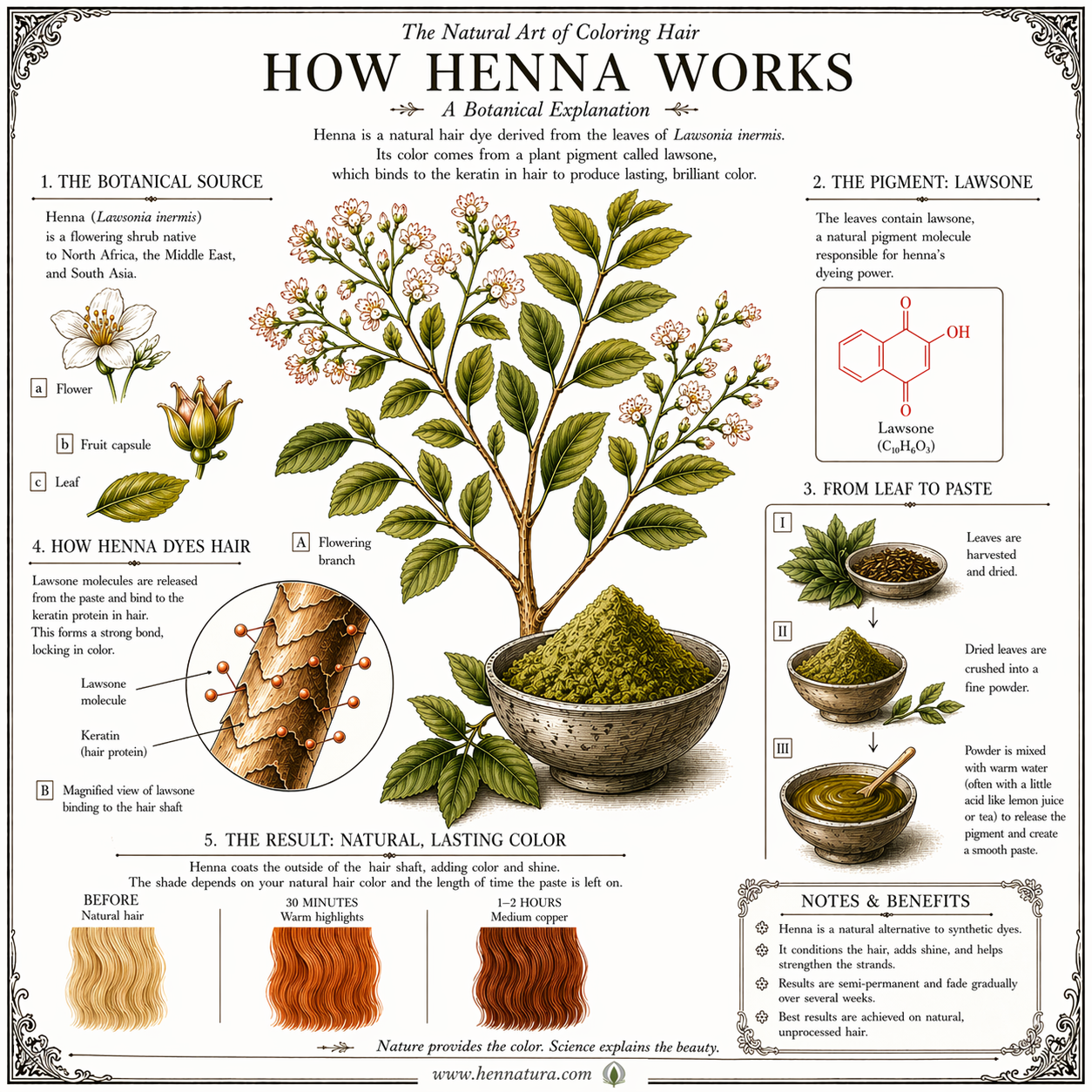
Henna derives its coloring ability from a naturally occurring molecule called lawsone (2-hydroxy-1,4-naphthoquinone).
This pigment has a remarkable property: it forms a direct bond with keratin, the primary protein that makes up the hair fiber.
Unlike synthetic dyes, which rely on oxidative chemical reactions inside the hair shaft, lawsone operates through a binding mechanism at the surface and near-surface layers of the hair. This distinction defines both the visual result and the overall hair experience.
When applied correctly, lawsone molecules migrate from the plant paste and attach to the hair, creating a stable and long-lasting color.
How Henna Interacts with the Hair Fiber
Human hair consists of overlapping cuticle layers that protect the inner cortex. Henna-based dyes do not need to disrupt this structure.
Instead, they:
- Bind to the outer keratin layers
- Lightly penetrate the upper regions of the cortex
- Accumulate gradually with repeated applications
This process creates a translucent color layer rather than an opaque coating.
As a result, your natural hair color continues to influence the final shade. Light reflects through both the henna layer and your original pigment, producing a tone that appears more dimensional and alive.
The Conditioning Effect of Botanical Color
Beyond its coloring properties, henna is also valued for its natural conditioning effect on the hair. As lawsone binds to the keratin structure, it forms a fine, protective layer along the hair shaft. This can enhance smoothness, improve light reflection, and give the hair a stronger, more resilient feel. Many people notice increased shine, improved texture, and a reduction in the appearance of surface damage over time. Additionally, henna based dyes protect your hair from damage caused by UV light.
Rather than relying on synthetic coatings, botanical color works in alignment with the hair’s structure—resulting in a finish that feels both cared for and naturally refined.
Why Results Look So Natural
Because henna does not bleach or remove your natural pigment, it cannot create a completely uniform or artificial color.
Instead, it enhances what is already there.
On lighter hair, henna produces vibrant copper and red tones. On darker hair, it adds warmth, depth, and red undertones that become more visible in sunlight.
This interaction between plant pigment and natural melanin creates a multi-dimensional effect that synthetic dyes often struggle to replicate.
The Role of Oxidation
After application, henna color continues to develop through a natural process known as oxidation.
In the hours and days following treatment:
- The initial bright tone deepens
- The color stabilizes
- Undertones become more refined
This transformation reflects the ongoing interaction between lawsone and oxygen in the air.
Traditional henna formulations often show a noticeable shift during this phase, sometimes becoming darker or more brown than expected.
At Hennatura, we refine this process through carefully balanced botanical compositions, guiding the color toward its intended tone more efficiently and reducing excessive post-application variation.
Beyond Henna: Botanical Blending
While pure henna produces a characteristic red / orange tone, modern plant-based formulations often combine multiple botanical sources to expand the shade range.
These may include:
- Indigo for deeper or brown tones
- Cassia for softness and light reflection
- Other plant pigments for tonal balance
- Manjistha for richer or cooler red tones
- and more
At Hennatura, we use multi-botanical pigment blending to create shades that feel more nuanced and controlled, while preserving the integrity of plant-based color.
This approach allows us to design tones that remain natural, yet more adaptable to different starting hair colors.

A More Considered Approach
Understanding how henna works reveals why plant-based hair dye feels fundamentally different.
It relies on:
- Direct pigment binding
- Gradual layering
- Interaction with natural hair color
This combination creates results that feel softer, more dimensional, and inherently individual.
At Hennatura, we build on these principles with a focus on control, balance, and refinement, bringing a more predictable and stable experience to botanical hair color—without compromising its natural character.
or